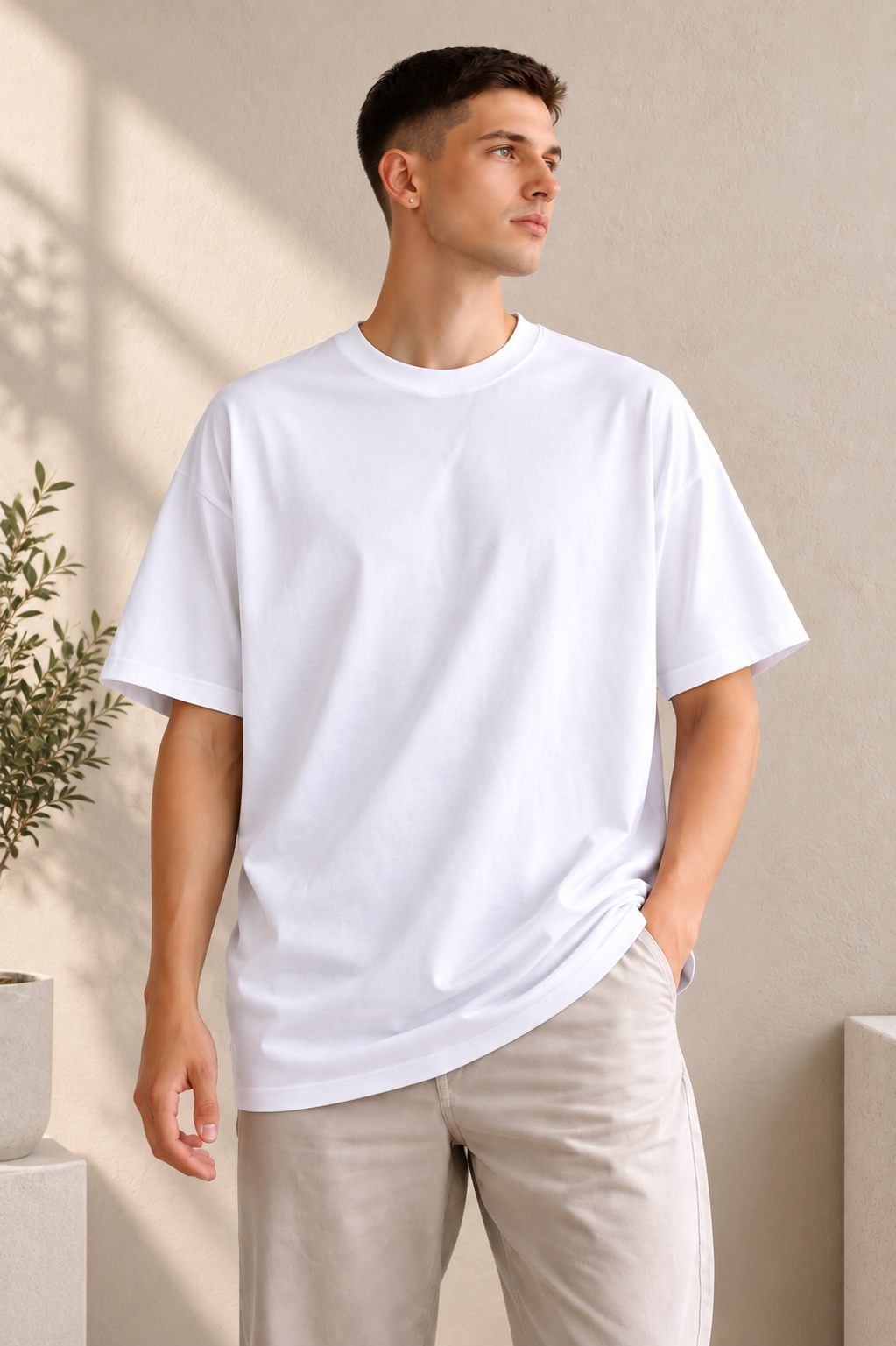
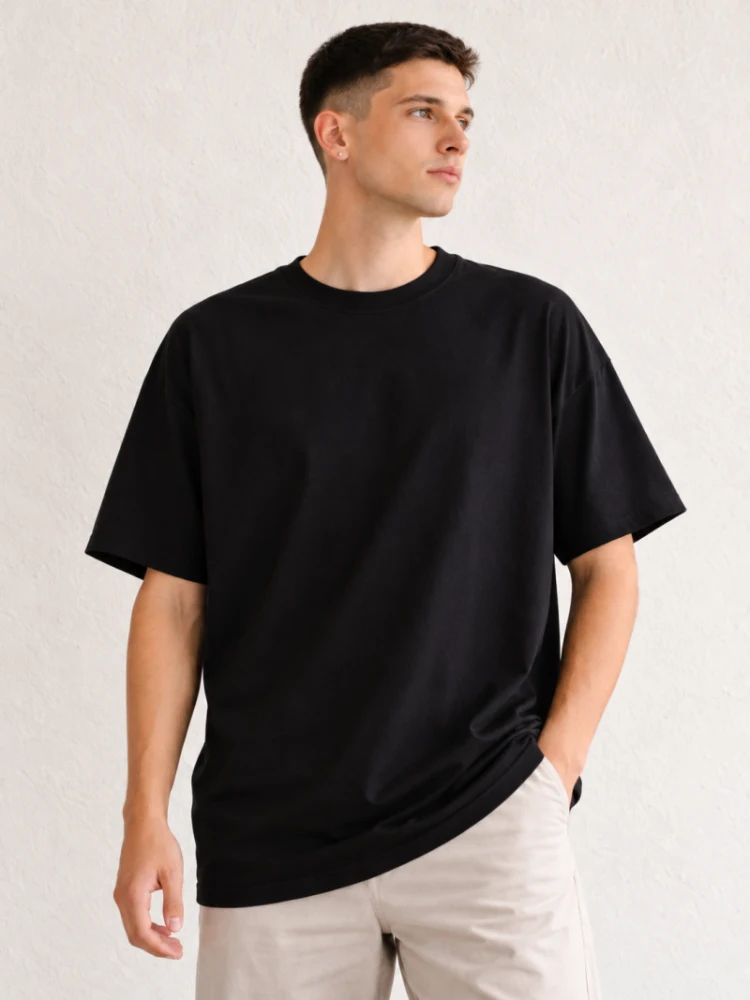
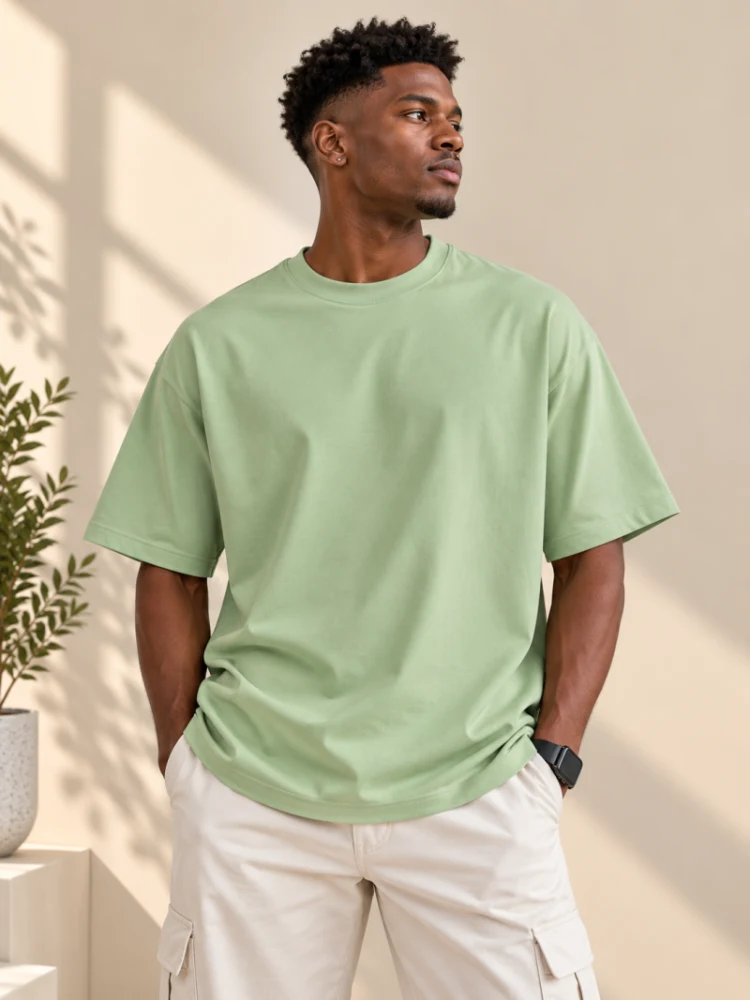
You buy a white tee online. It looks great on day one. After a handful of washes the collar waves, the hem twists, and in bright light you can see straight through it. Often the cause isn't how you washed it. It's the fabric weight, a number that rarely appears on the label: GSM.
This guide explains what GSM means in a t-shirt, which weights suit which kind of tee, how to check it before you buy, and why we at Danvi Style chose 220 GSM for everything we make. It is useful whether you shop with us or not.
In this guide
- What GSM means in a t-shirt
- GSM ranges at a glance
- Why fabric weight matters
- Why GSM isn't everything
- Is 220 GSM too heavy for Indian weather?
- Why we chose 220 GSM at Danvi Style
- How to check GSM before you buy
- How to care for a heavyweight tee
- Frequently Asked Questions
What is GSM in a t-shirt?
GSM stands for grams per square metre. Take a piece of fabric measuring one metre by one metre and weigh it: the number of grams is its GSM. A tee at 220 GSM carries about 220 grams of fabric in every square metre.
That number tells you how much material is in the cloth, and therefore how dense it is. More material per square metre usually means a thicker feel, better opacity, and more structure. Less means lighter and airier, but often thinner and quicker to lose its shape.
GSM describes weight only. It says nothing about the quality of the fibre, the yarn, or the stitching, which we explore below.
GSM ranges at a glance
There is no official standard, and brands label these ranges differently. Some call 220 GSM midweight and others call it heavyweight. Treat this table as a practical guide:
| GSM (approx.) | Common Label | How it feels | Best for |
|---|---|---|---|
| Under 160 | Lightweight | Thin, airy, close to the body | Peak summer, gym wear, layering |
| 160 to 200 | Midweight | Soft, balanced | Everyday casual tees |
| 200 to 240 | Heavyweight | Dense, structured, opaque | Oversized fits, year-round basics |
| 240 and above | Extra heavy | Thick, boxy, very sturdy | Cooler months, streetwear looks |
220 GSM sits right in the heavyweight row: dense enough to hold a clean line, but not so thick that it feels like a sweatshirt.
Why fabric weight matters
You notice four distinct things when a tee has real weight to it:
- It holds its shape. Denser fabric resists stretching at the collar and twisting at the hem, so the tee looks the same in month six as in week one.
- It isn't see-through. More material means better opacity, which matters most in white and light colours.
- It drapes cleanly. In a relaxed or oversized cut, a heavier fabric falls straight from the shoulder instead of clinging or collapsing into creases.
- It lasts longer. More cotton per square metre generally means more wear before the fabric starts to thin.
The Cost-Per-Wear Principle
A simple way to judge price is cost per wear. Say a ₹400 tee loses its shape after about 40 wears, while a ₹700 tee stays good for about 150. The first costs ₹10 a wear and the second costs under ₹5. These numbers are an illustration, but the logic holds: a sturdier tee that stays wearable for longer costs less in the long run.
Why GSM isn't everything
A high number alone doesn't make a good tee. A heavy fabric spun from rough, short fibres just feels stiff, and a well-made lighter tee can outlast a carelessly made heavy one. Four things matter alongside weight:
- Fibre: Long-staple cotton has longer fibres, which spin into smoother, stronger yarn.
- Combing: Combing removes the shorter, weaker fibres and leaves a cleaner, softer yarn. A combed cotton tee feels dense and soft at the same time.
- Construction: Even knitting, clean seams, and a firm neckband. A weak collar ruins good fabric.
- Fit: An oversized cut needs structure to look intentional rather than shapeless.
The takeaway: look for weight, fibre, and finishing together—not just a single number.
Is 220 GSM too heavy for Indian weather?
The honest answer is that it depends on where you live and when you wear it. India has many climates, and no single weight suits all of them.
- Cotton breathes naturally, and a relaxed oversized cut lets air move around the body, which helps a dense fabric feel comfortable.
- 220 GSM works remarkably well in air-conditioned offices, homes, commutes, through the cooler months, and in the in-between transitional seasons.
- In the hottest peak weeks in cities like Delhi, some people prefer a lighter tee for long walks outdoors.
If you run warm, choose a lighter colour (like Chalk White or Pistachio) and a looser size. We see 220 GSM as a tee for most of the year, with the peak of summer being a personal call.
Why we chose 220 GSM at Danvi Style
Our core idea is calm confidence: clothes that let you stop thinking about what you're wearing. A tee can't do that if it twists, stretches, or turns see-through, so we started with the fabric. Each of our three brand pillars shows up in that choice:
- Timeless aesthetics: A dense fabric holds a clean architectural line that doesn't date.
- Minimal detailing: With no loud prints or branding, the fabric and the fit do all the work, so they have to be right.
- Functional design: Comfort that lasts through a whole day, not just the first hour.
Every tee we make is cut from long-staple Indian combed cotton at 220 GSM, designed and tailored in our Delhi NCR workshop, and inspected before dispatch.
We offer it in two series:
- Stillwear: The classic plain tee with no prints—just the honest fabric and the fit.
- Few Words: The same substantial tee with one quiet, deliberate typographic line.
The fabric and fit are identical across both series, so you are only choosing a style, never a quality level.
How to check GSM before you buy any t-shirt
- Look for the number. A brand proud of its fabric will state the GSM on the product page. Vague words like "premium" or "thick" tell you nothing.
- Feel the weight. Hold the tee up. A dense one has noticeable heft and doesn't flutter in a slight draft.
- Hold it to the light. A white tee you can see through in daylight is light or loosely knit.
- Check the neck and hems. The neckband should lie flat and feel firm, and the hem should be neatly stitched with twin-needle finish.
- Check the fibre. Look for 100% cotton, and ideally combed, long-staple cotton.
- Read reviews after a few washes. First impressions are easy. How the tee looks months later is what truly counts.
How to care for a heavyweight cotton tee
A good tee needs very little maintenance. A few simple habits keep it sharp for years:
- Wash cold or on a gentle cycle (30°C) with similar colours.
- Turn it inside out to protect the surface texture and any print.
- Dry in the shade. Hot tumble dryers stress natural cotton fibres and cause shrinkage.
- Skip bleach and heavy fabric softeners that leave waxy chemical residues.
- Fold it rather than hanging it on thin wire hangers, so the shoulders don't stretch under their own weight.
Frequently Asked Questions (FAQs)
What does GSM mean in a t-shirt?
GSM means grams per square metre. It is the weight of one square metre of the fabric and a quick way to compare how dense one tee is against another.
What is a good GSM for a t-shirt?
It depends on how you wear it. Around 160 to 200 GSM suits everyday casual tees. Tees at 200 GSM and above feel more structured and hold their shape better, which suits oversized fits.
Is 220 GSM good for an oversized t-shirt?
Yes. At 220 GSM the fabric has enough structure to fall cleanly from the shoulder, so a relaxed cut looks deliberate rather than baggy.
Is higher GSM always better?
No. Fibre quality, combing, construction, and your climate matter too. A poorly made heavy tee can feel worse than a well-made lighter one.
Is a 220 GSM t-shirt too hot for summer?
Cotton is breathable and an oversized cut lets air move, so many people wear 220 GSM through most of the year. In the hottest weeks, a lighter colour and a looser size help, and some people simply prefer a lighter tee.
How can I tell the GSM of a t-shirt?
Check the product page first. If you have a spare piece of the fabric, cut a 10 cm by 10 cm square, weigh it in grams, and multiply by 100.
How should I wash a heavyweight cotton tee?
Wash it cold or on a gentle cycle, turn it inside out, dry it in the shade, and avoid bleach and strong chemical softeners.
The short version
Fabric weight is the quietest detail on a t-shirt and the one you feel most over time. GSM isn't the whole story, but paired with long-staple combed cotton and careful finishing, it's the difference between a tee you replace and a tee you keep.
That is the idea behind everything we make at Danvi Style: calm confidence, built in 220 GSM combed cotton.